sábado, 28 de março de 2009

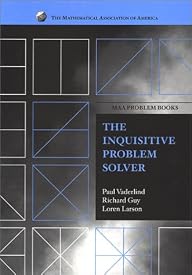
The Inquisitive Problem Solver

(MAA Problem Book Series)
Paul Vaderlind, Richard K. Guy, Loren C. Larson

The Mathematical Association of America | 2002 | 344 páginas | Djvu | 5,3 Mb

link direto
link
link1
depositfiles.com
mediafire.com

Referência em: MathEduc

The Inquisitive Problem Solver is a collection of mathematical miniatures composed to stimulate and entertain. On a deeper level, these little puzzles, accessible to a general audience, provide a setting rich in mathematical themes. One of the larger purposes of the book is to show how everyday situations can lead an inquisitive problem solver to profound and far-reaching mathematical principles. Discussions accompanying the problems reinforce important techniques in discrete mathematics, and the solutions - which require verbal arguments - show that proofs and careful reasoning are at the core of doing mathematics. In addition, anyone reading this book will learn that asking good questions is just as important to the progress of mathematics as answering questions. The book contains more than a dozen open problems for further research by amateurs or professionals. This treasury of problems will serve as a resource for anyone seeking to improve their problem-solving knowledge and know-how.

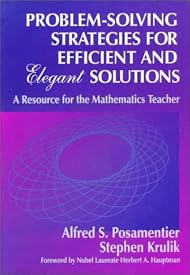
Problem-Solving Strategies for Efficient and Elegant Solutions: A Resource for the Mathematics Teaches


Alfred S. Posamentier, Stephen Krulik

Corwin Press | 1998 | 272 páginas | DJVU | 2,2 MB

link
link1
depositfiles.com
depositfiles.com

"This book is unique in that it provides alternatives to traditional problem-solving methods used by teachers. It is an attempt to break the mold of looking at only one way to solve a problem. The authors investigate ten strategies that can be used to solve mathematics problems as well as real life situations, using approximately 200 problems to demonstrate the ten strategies."

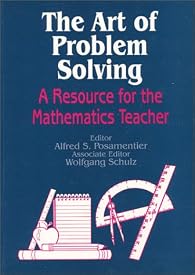
The Art of Problem Solving: A Resource for the Mathematics Teacher

Alfred S. Posamentier, Wolfgang Schulz

Corwin Press | 1995 | 480 páginas | DJVU | 3,8 MB

link
link1
depositfiles.com


Referência em: MathEduc

Problem solving has always been a fundamental element of mathematics. This innovative book challenges the perception that solving a problem is merely a means to an end. Focusing on problem solving as a subject in its own right, the contributors present a broad range of practical, theoretical, simple, intricate and purely mathematical examples.

Ants, Bikes, and Clocks: Problem Solving for Undergraduates

William Briggs

IAM: Society for Industrial and Applied Mathematics | 2004 | 174 páginas | PDF | 1 Mb

link
link1

djvu | 1,7 Mb

link
link1

PDF - 10 Mb - sma1pekalongan.sch.id (link direto)


Referência em: MathEduc

Mathematics educators agree that problem solving is one of the essential skills their students should possess, yet few mathematics courses or textbooks are devoted entirely to developing this skill. Supported by narrative, examples, and exercises, Ants, Bikes, and Clocks: Problem Solving for Undergraduates is a readable and enjoyable text designed to strengthen the problem-solving skills of undergraduate students. The book, which provides hundreds of mathematical problems, gives special emphasis to problems in context, often called story problems or modeling problems, that require mathematical formulation as a preliminary step. Both analytical and computational approaches, as well as the interplay between them, are included. This engaging book will strengthen students' mathematical skills, introduce them to new mathematical ideas, demonstrate the connectedness of mathematics, and improve both their analytical and computational problem solving. Students are encouraged to use the computer, or any tool at hand, for experimentation or to test their ideas

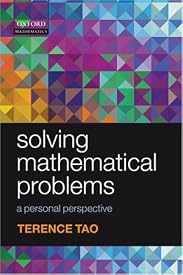
Solving Mathematical Problems: A Personal Perspective

Terence Tao

Oxford University Press | 2006 | 128 páginas | Djvu | 1,2 Mb
link
depositfiles.com
4shared.com

PDF - 1,5 Mb
link
rapidgator.net

Referência em: MathEduc

Authored by a leading name in mathematics, this engaging and clearly presented text leads the reader through the various tactics involved in solving mathematical problems at the Mathematical Olympiad level. Covering number theory, algebra, analysis, Euclidean geometry, and analytic geometry, Solving Mathematical Problems includes numerous exercises and model solutions throughout. Assuming only a basic level of mathematics, the text is ideal for students of 14 years and above in pure mathematics.

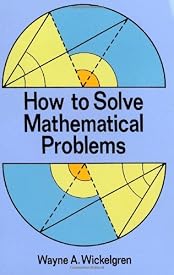
How to Solve Mathematical Problems

Wayne A. Wickelgren

Dover Publications | 272 páginas | Djvu | 2,4 MB

link
link1
depositfiles.com
4shared.com

Referência em: MathEduc

Seven problem-solving techniques include inference, classification of action sequences, subgoals, contradiction, working backward, relations between problems, and mathematical representation. Also, problems from mathematics, science, and engineering with complete solutions.

Problem-Solving Studies in Mathematics


John G. Harvey e Thomas A. Romberg

Wisconsin Research and Development Center for Individualized Schooling monograph series | 1980 | 287 páginas | pdf | 3,97 MB

on-line: eric (Nenhum link disponível)

This monograph focuses on educational research on the processes and natures of problem-solving activities in mathematics. The first chapter presents an overview to both the field and the document itself. All of the studies reported reflect interrelated investigations carried out at the University of Madison-Wisconsin, as partial fulfillments of Ph.D. requirements in Mathematics or Curriculum and Instruction. Chapter two describes 31 studies carried out between 1969 and 1978, and divides the research into three categories: instruction in heuristics, assessment of problem-solving performance, and correlates and factors of problem-solving performance. The next four sections are reports of studies on teaching problem solving, chapters seven and eight detail investigations on assessing problem-solving performance, and the last three portions describe studies on establishing correlates and factors of problem-solving performance.