Acesso ao primeiro capítulo dos manuais desde o pré-escolar até ao 6.º ano de escolaridade.
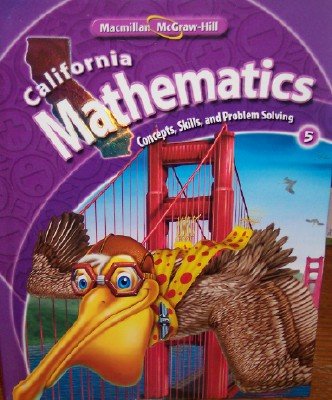
Grade 5
McGraw-Hill | 2009 | 723páginas | PDF | 86 Mb
Ano de escolaridade: 5.º ano
link
link1
Chapter 1 Number Sense, Algebra, and Functions
Chapter 2 Statistics and Data Analysis
Chapter 3 Adding and Subtracting Decimals
Chapter 4 Fractions and Decimals
Chapter 5 Adding and Subtracting Fractions
Chapter 6 Multiplying and Dividing Decimals and Fractions
Chapter 7 Algebra: Integers and Equations
Chapter 8 Ratio, Proportion, Algebra, and Functions
Chapter 9 Percent and Probability
Chapter 10 Geometry: Angles and Polygons
Chapter 11 Measurement: Perimeter, Area, and Volume
Looking Ahead

Grade 6
Ano de escolaridade: 6.º ano
Glencoe/McGraw Hill | 2008 | 793 páginas| PDF| 58,2 Mb
link
link1
ou
glencoe.com
Access code: DB40A77FA9
Site do Manual: glencoe.mcgraw-hill.com
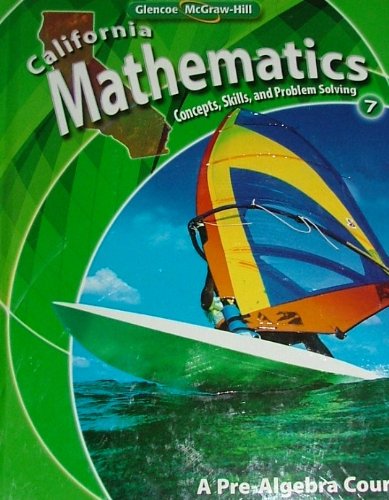
Rhonda J. Moix-Bailey, Roger Day, Patricia Frey
Glencoe/Mcgraw-Hill | 2008 | 791 páginas| PDF | 54 MB
Ano de escolaridade: 7.º ano
link
link1
ou
glencoe.com
Access code: D540730212
Site do Manual: glencoe.mcgraw-hill.com
"California Mathematics: Concepts, Skills, and Problem Solving" was developed to specifically target the skills and topics that give students the most difficulty. It includes diagnostic, formative, and summative assessment; data-driven instruction; intervention options; and performance tracking, as well as remediation, acceleration, and enrichment tools throughout the program.
Reading age for native speakers: Middle School students (7th grade)
C A V E A T: This is an encrypted, READ-ONLY edition of the book!
CONTENTS
Start Smart – Be a Better Problem Solver
- A Plan for Problem Solving
- Problem-Solving Strategies
- Multi-Step Problems
- Tools for Problem Solving
- Techniques for Problem Solving
- How to Use Your Math Book
- Why do I Need my Math Book?
- Doing Your Homework
- Studying for a Test
- Scavenger Hunt
- California Data File
Unit 1: Number and Operations: Rational and Real Numbers
Chapter 1: Algebra: Integers
Chapter 2: Algebra: Rational Numbers
Chapter 3: Real Numbers and the Pythagorean Theorem
Unit 2: Patterns, Relationships, and Algebraic Thinking
Chapter 4: Proportions and Similarity
Chapter 5: Percent
Unit 3: Geometry and Measurement
Chapter 6: Geometry and Spatial Reasoning
Chapter 7: Measurement: Area and Volume
Unit 4: Algebraic Thinking: Linear and Nonlinear Functions
Chapter 8: Algebra: More Equations and Inequalities
Chapter 9: Algebra: Linear Functions
Chapter 10: Algebra: Nonlinear Functions and Polynomials
Unit 5: Statistics, Data Analysis, and Probability
Chapter 11: Statistics
Standards Review
Chapter 12: Looking Ahead to Grade 8: Probability
Student Handbook
- Built-In Workbooks
-- Prerequisite Skills
-- Extra Practice
-- Mixed Problem Solving
- Reference
-- English-Spanish Glossary
-- Selected Answers
-- Photo Credits
-- Index