sábado, 14 de março de 2009

The Golden Ratio: The Story of Phi, the World's Most Astonishing Number


Mario Livio

Broadway | 2002 | 320 páginas| PDF | 2 mb

link
link1

4shared.com
scribd.com

epub - 6,3Mb
link
link1

Mobi - 7 Mb
link


Comentário em: plus.maths.org

Throughout history, thinkers from mathematicians to theologians have pondered the mysterious relationship between numbers and the nature of reality. In this fascinating book, Mario Livio tells the tale of a number at the heart of that mystery: phi, or 1.6180339887...This curious mathematical relationship, widely known as "The Golden Ratio," was discovered by Euclid more than two thousand years ago because of its crucial role in the construction of the pentagram, to which magical properties had been attributed. Since then it has shown a propensity to appear in the most astonishing variety of places, from mollusk shells, sunflower florets, and rose petals to the shape of the galaxy. Psychological studies have investigated whether the Golden Ratio is the most aesthetically pleasing proportion extant, and it has been asserted that the creators of the Pyramids and the Parthenon employed it. It is believed to feature in works of art from Leonardo da Vinci's Mona Lisa to Salvador Dali's The Sacrament of the Last Supper, and poets and composers have used it in their works. It has even been found to be connected to the behavior of the stock market! The Golden Ratio is a captivating journey through art and architecture, botany and biology, physics and mathematics. It tells the human story of numerous phi-fixated individuals, including the followers of Pythagoras who believed that this proportion revealed the hand of God; astronomer Johannes Kepler, who saw phi as the greatest treasure of geometry; such Renaissance thinkers as mathematician Leonardo Fibonacci of Pisa; and such masters of the modern world as Goethe, Cezanne, Bartok, and physicist Roger Penrose. Wherever his quest for the meaning of phi takes him, Mario Livio reveals the world as a place where order, beauty, and eternal mystery will always coexist.

Pleasures of Pi, e and Other Interesting Numbers


Y. E. O. Adrian

World Scientific Publishing Company | 2006 | 268 páginas | PDF | 22 Mb

link
link1

Descrição: This is a mathematics book written specifically for the enjoyment of non-mathematicians and those who hated math in school. The book is organized into two sections: (I) Beauty for the Eye (shallow water for the non-swimmer); and (II) A Feast for the Mind (slowly getting deeper for the more adventurous).

sexta-feira, 13 de março de 2009

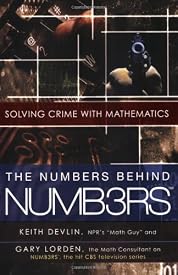
The Numbers Behind NUMB3RS: Solving Crime with Mathematics

Keith Devlin, Gary Lorden

Plume | 2007 | 256 páginas | PDF | 4 Mb

link
link1

Using the popular CBS prime-time TV crime series Numb3rs as a springboard, Keith Devlin (known to millions of NPR listeners as ?the Math Guy? on NPR?s Weekend Edition with Scott Simon) and Gary Lorden (the principal math advisor to Numb3rs) explain real-life mathematical techniques used by the FBI and other law enforcement agencies to catch and convict criminals. From forensics to counterterrorism, the Riemann hypothesis to image enhancement, solving murders to beating casinos, Devlin and Lorden present compelling cases that illustrate how advanced mathematics can be used in state-of-the-art criminal investigations.

The Language of Mathematics: Making the Invisible Visible


Keith Devlin

W.H. Freeman & Company | 1998 | 344 páginas | PDF 


link
4shared.com
scribd.com
uploading.com
rapidgator.net


Referência em: MathEduc


Keith Devlin reveals the role mathematics plays in our eternal quest to understand who we are and the world we live in. More than just the study of numbers, mathematics provides us with the eyes to recognise and describe the hidden patterns of life. Supported with a variety of examples including - what keeps a jumbo jet in the air, how we forecast the weather and predict changes in the stock market, Devlin shows how mathematics can be used to describe and explain the world about us.

Fractions, Decimals, Ratios, and Percents: Hard to Teach and Hard to Learn?


Mathematics teaching cases
Carne Barnett, Babette Jackson, Donna Goldenstein

Heinemann | 1994 | 124 páginas

Anos de escolaridade: 3.º ao 8.º

on-line: ERIC (Nenhum link disponível)


This book presents teacher-written cases relating stories, insights, and experiences about the teaching of fractions, decimals, ratios, and percents. The cases were written to stimulate colleagues to examine their own practice, to think hard about the mathematics they teach and would like to teach, and to initiate inquiries and discussions that lead teachers to a deeper understanding of student thinking and the kinds of strategies that would promote further learning. The typical case reports a problem, dilemma, or crisis of mathematics instruction that has occurred in a teacher's class and describes the events that led up to the problem, the classroom context in which it occurred, and the ways in which the teacher attempted to set matters on course. Also included is the teacher's own analysis of the situation and the emotional impact of the problem. Major section headings in the book are: "Inside Student Thoughts,""Making Sense or Memorizing Rules,""Teaching as Questioning,""Reflecting,""Manipulatives Aren't Magic,""What Next," Connections," and "This Wasn't My Plan."

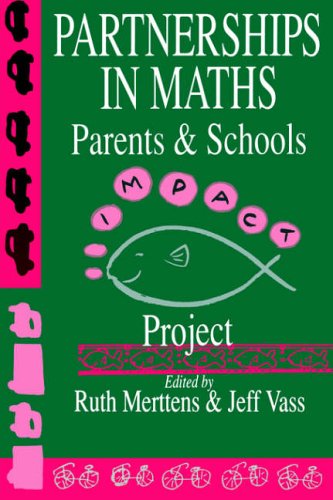
Partnership In Maths: Parents And Schools The Impact Project


Ruth Merttens

Routledge | 1993| 264 páginas

on-line: ERIC (PDF | 3,28 MB)

The IMPACT Project is a parental involvement initiative originating in London, England. This book aims at a kaleidoscopic approach reflecting a variety of perspectives on the work in this project over five years. Chapters are grouped according to particular aspects of parental involvement. Part I, "Starting IMPACT," contains only one chapter: "IMPACT: Pride, Prejudice and Pedagogy: One Director's Personal Story" (Ruth Merttens). Part II, "Doing IMPACT," contains five chapters: "IMPACT and the Early Years Classroom" (Chris Tye), "Maths in My Home" (Sue Hunter), "A Probationer's Year on IMPACT's Probationary Year" (Kerry Carrie), "IMPACT: A Parent's Personal Perspective" (Sylvia Harrison), and "IMPACT: Does It Really Make a Difference? A Teacher's Personal View" (Linda Calvert). Part III, "Supporting IMPACT," contains five chapters: "IMPACT: A Humberside Perspective" (Alwyn Morgan and Paul Tremere). "IMPACT in the Urban Authority" (David Brostow), "IMPACT: Changes in a Support Teacher's Role" (Margaret Williams), "Child-Centeredness, IMPACT and the National Curriculum" (Ian Lewis), and "IMPACT at the Core of the Curriculum: The Work of a Primary Maths Adviser in the New Era" (David Owen). Part IV, "Research in the Area," contains five chapters: "Parents in the New Era: Myth and Reality?" (Martin Hughes, Felicity Wikeley, and Tricia Nash), "Parental Partnerships: Comfort or Conflict?" (Richard Border and Ruth Merttens), "IMPACT and Cultural Diversity" (Deborah Curle), "Practising Mathematics Education: A Context for IMPACT (Lin Taylor and John Smith), and "IMPACT In-Service Training: A View from the Centre of the Web" (Ruth Merttens). Part V, "Reflections," contains six chapters: "Parental Involvement from Policy to Practice: An Education Officer's View" (Tim Brighouse), "Special Needs, Parents and the Education Reform Act" (Gary Thomas), "Participation, Dialogue and the Reproduction of Social Inequalities" (Andrew Brown), "Marginal Dialogues, Social Positions and Inequity in Rhetorical Resources" (Jeff Vass), "Family Math in Toronto" (Peter Saarimaki), and "Including Parents: The Dynamics of Resistance" (Dorothy Hamilton and Deryck Dyne).


How Social and Emotional Development Add Up: Getting Results in Math and Science Education


(Social Emotional Learning, 4)
Norris M. Haynes, Michael Ben-Avie, Jacque Ensign, Ed.

Teachers College Press | 2003 | 208 páginas| pdf | 1 Mb

link

This landmark volume is essential reading for math and science teachers who are eager to find creative and stimulating ways to engage student's interest and to boost their academic performance. A stellar group of contributors, including both psychologists and teachers, outlines the principles of social emotional learning (SEL) that educators can follow to help "all students to achieve in the math and science classroom. Focusing on inner-city schools and the particular needs of African American students, the text: -Presents a substantial body of empirical research, including findings of the Third International Math and Science Study-Builds on what we already know about social and emotional factors in learning and applies it to the math and science curriculum, shedding new light on ways to help young people succeed academically-Features many examples of successful math and science instruction that teachers can incorporate into their own classrooms-Covers key topics, such as youth development, connecting with students, math-science readiness and policy, developmental pathways to achievement, success for minority students, equity and excellence, preparing students for the future, and corporate partners in the classroom