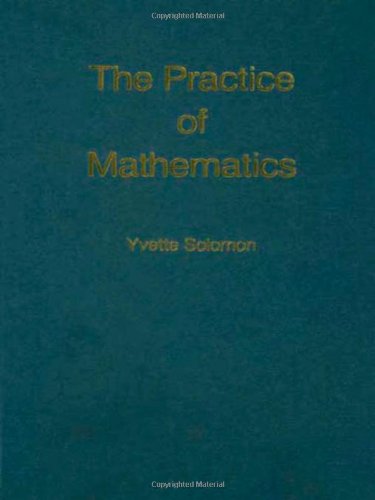
Routledge | 1989 | 211 páginas | rar - pdf | 6 Mb
link (password: matav)
The psychological description and explanation of how children learn to work with numbers is dominated by the theories of Piaget. Yvette Solomon suggests an alternative approach to the child's conception of number.
Contents
Acknowledgements
1. The development of the number concept as a field of psychological investigation
2. Why does Piaget's theory take its particular form? 9
The background to Piaget's explanation: the status and nature of mathematical propositions 10
Mathematics and genetic epistemology: the relation between logic and psychology 18
3. The child's conception of number 28
Piaget's criticisms of intuitionism and logicism 28
Piaget's synthesis of order and class 36
4. Piaget's account of the growth of understanding 43
Piaget's criticisms of empiricism and rationalism 43
Growth as a synthesis of genesis and structure 48
5. Does Piaget give an adequate account of growth? 66
The transition from weaker to stronger logics 67
Reflective abstraction and the growth of knowledge 70
'The individual constructs his world': Piaget's account of objective knowledge 75
6. Do number theorists give adequate accounts of knowing? 79
Piaget's essentialism 80
Bryant's work 89
Gelman and Gallistel' s work 99
7. Can a Piagetian perspective be defended? 109
Socio-cognitive conflict and the growth of knowledge 110
Information-processing theory and Piagetian theory: Case's 'neo-Piagetian' analysis 119
8. Knowing how and when to use numbers 131
Linguistic, non-linguistic and social contexts, and psychological experiments 131
The context of doing arithmetic 147
Understanding the context of doing arithmetic 150
9. 'The development of mathematical thinking ': entering into the social practices of number use 160
Analysing social practices 161
Entering into social practices 179
Notes 188
References 193
Index 200
Outros livros da mesma autora:
 |
Idioma: Inglês
Editora: New York : Routledge, 2009.
|
 |
Publicação de conferência
Idioma: Inglês
Editora: New York : Routledge, 2009.
|

Sem comentários:
Enviar um comentário