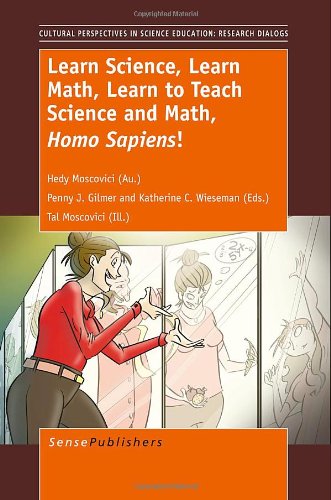
Hedy Moscovici, Penny J. Gilmer e Katherine C. Wieseman
Sense Publishers | 2012 | páginas | rar - pdf | 2,9 Mb
link (password : matav)
Dr. Hedy Moscovici's life on three continents and her battle with ovarian cancer shaped the unique co-learning and participative leadership perspective on science and mathematics education shared in this book. This text has multiple audiences - prospective and practicing teachers wanting to motivate their students to learn, science and mathematics educators mentoring teachers to become transformative intellectuals and critical pedagogues, parents interested in their children's advancement, and interested policymakers and public wishing to deepen their understanding about learning in general and educational issues in science and mathematics. Two mottos, "I can't learn from you if you can't learn from me" and "to teach is to learn twice," summarize the essence of her message. The spotlight is on the critical interdependence of factors, specifically human ability to construct understanding; necessity of disequilibrium to spark neural rewiring; cognition-emotion (pleasure vs. pain, even science or math phobia) connections; sociocultural context; dilemma created by the absence of a clearly trustworthy "learning meter" for a society valuing objective measurement of quality of learning; human relationships sustained by three R's (rights, responsibilities, respect); and, heightened awareness of power relationships leading to a spirit of collaboration, recognition of each individual's strengths and expertise; and critical pedagogy.
TABLE OF CONTENTS
Illustrations.............. ix
Dedication ................... xi
Acknowledgements ............ xiii
Abbreviations ............. xv
Foreword (by Katherine Wieseman and Penny J. Gilmer) ....... xvii
Chapter 1 Worldview as a Dynamic Entity ...... 1
Chapter 2 What Do You Mean, You Know Science and Mathematics? ..... 17
Chapter 3 Emotional and Intellectual Involvement While Learning Science and Mathematics ... 37
Chapter 4 Learning to Teach/Teaching to Learn Science and Mathematics ... 63
Chapter 5 Leadership as Effective Collaborations in Science and Mathematics ..... 87
Chapter 6 Who Needs Science and Mathematics? ..... 101
Bibliography ........ 117
Index ........... 127

Olá!
ResponderEliminarO link deste livro abre uma página em branco (não leva para nenhum site).
Pode verificar, por favor ?
Obrigado !
Obrigada,
EliminarExperimente agora