Marie Larochelle
Sense Publishers | 2009 | 339 páginas | rar - pdf | 1,62 Mb
link (password: matav)
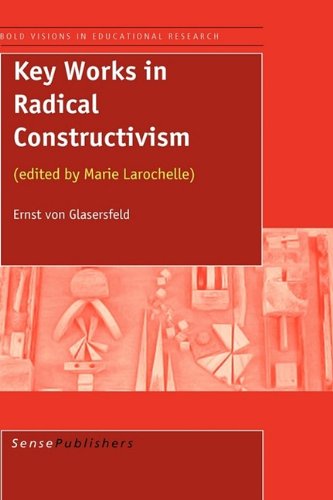
Key works on radical constructivism brings together a number of essays by Ernst von Glasersfeld that illustrate the application of a radical constructivist way of thinking in the areas of education, language, theory of knowledge, and the analysis of a few concepts that are indispensable in almost everything we think and do. Ernst von Glasersfeld's work opens a window on how we know what we know. The present work grew out of a desire to make more accessible this line of thought, to highlight its originality and consistency, and to illustrate its fecundity in the domains of cognition and learning. The first three parts of this book contain texts by Glasersfeld that outline the constructivist approach and explicate the frequently drastic reconceptualizations he has suggested. Both the last part and the postscript consist of commentaries by Edith Ackermann, Jacques Désautels, Gérard Fourez, Leslie P. Steffe and Kenneth Tobin, scholars in the fields that Glasersfeld has been concerned with. They examine a number of critical aspects pertaining to (radical) constructivism's current and future development, often tracing out paths that warrant further exploration and reflection, in particular concerning the sociopolitical dimension of knowledge. Key works on radical constructivism is intended as a reference book for researchers, educators, and students of education-and for anyone interested in grasping, or deepening their grasp of, radical constructivism's tenets, ambitions and concerns. Readers will discover in this collection of firsthand contributions the contours of a bold, contemporary debate about a most compelling current of thought. Ernst von Glasersfeld was brought up with more than one language from the very beginning. This taught him early on that the realities people think and talk about are noticeably different. He was much influenced by Silvio Ceccato, the founder of the Operational School in Italy, and then by Jean Piaget's Genetic epistemology, to which, he believes, he was able to add some details. He worked as a language analyst at the Center for Cybernetics in Milan, directed a language research project for the Us Air Force from 1962 to 1970, and then taught as professor of cognitive psychology at the University of Georgia, USA. In 1987 he retired at the age of 75 and became Research Associate at the Scientific Reasoning Research Institute of the University of Massachusetts. Throughout, his main interest was how we come to know what we know and how thought and language are linked. He has published several books in English, German, and Italian. Marie Larochelle is Full Professor at the Faculty of Education of Université Laval, Québec City. For many years, she has actively researched socioepistemological problems related to the teaching/learning of scientific knowledge. Her publications have been primarily in the fields of science education and constructivism. Her current research interests focus on how students and future science teachers figure or represent the conflicts, controversies, negotiations and socioethical issues that shape the practice of the technosciences.
CONTENTS
Preface (Ernst von Glasersfeld) vii
List of contributors ix
Acknowledgment of sources xi
INTRODUCTION: ERNST VON GLASERSFELD’S WAY OF WORLD MAKING xiii
Marie Larochelle
PART I: LEARNING, LANGUAGE, AND THE RADICAL THEORY
1. Learning as a constructive activity 3
2. Reconstructing the concept of knowledge 21
3. Facts and the self from a constructivist point of view 31
4. Signs, communication, and language 43
5. How do we mean? A constructivist sketch of semantics 55
6. On the concept of interpretation 63
7. Piaget and the radical constructivist epistemology 73
PART II: THEORY OF KNOWLEDGE
8. Aspects of constructivism: Vico, Berkeley, Piaget 91
9. The end of a grand illusion 101
10. The simplicity complex 111
11. The logic of scientific fallibility 119
12. The incommensurability of science and poetic wisdom 129
13. Farewell to objectivity 135
14. The radical constructivist view of science 143
15. Cybernetics and the theory of knowledge 153
PART III: CONCEPTUAL ANALYSES
16. Notes on the concept of change 173
17. Abstraction, re-presentation, and reflection. An interpretation of experience and of Piaget’s approach 179
18. Representation and deduction 199
19. A constructivist approach to experiential foundations of mathematical concepts 205
20. The conceptual construction of time 225
21. Anticipation in the constructivist theory of cognition 231
22. A constructive approach to ‘universals’ 241
PART IV: COMMENTS
23. Experiences of artifacts: People’s appropriations / objects’‘affordances’ 249
Edith Ackermann
24. Knowledge as representation 259
Gérard Fourez
25. A constructivist account of knowledge production as a social phenomenon and its relation to scientific literacy 267
Jacques Désautels
26. Radical constructivism and “school mathematics” 279
Leslie P. Steffe
POSTSCRIPT: THE REVOLUTION THAT WAS CONSTRUCTIVISM 291
Kenneth Tobin
References 299
Index of names 313
Index of subjects 319

Sem comentários:
Enviar um comentário