Springer | 1995 | 483 páginas | pdf | 30 Mb
link
link1
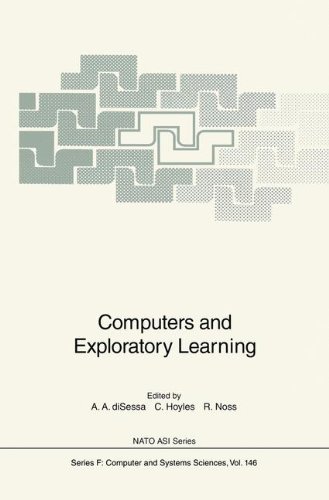
Computers are playing a fundamental role in enhancing exploratory learning techniques in education. This volume in the NATO Special Programme on Advanced Educational Technology covers the state of the art in the design and use of computer systems for exploratory learning. Contributed chapters treat principles, theory, practice, and examples of some of the best contemporary computer-based learning environments: Logo, Boxer, Microworlds, Cabri-Géomètre, Star Logo, Table Top, Geomland, spreadsheets, Function Machines, and others. Emphasis is on mathematics and science education. Synthetic chapters provide an overview of the current scene in computers and exploratory learning, and analyses from the perspectives of epistemology, learning, and socio-cultural studies.
Table of Contents
1. Computers and Exploratory Learning: Setting the Scene .... 1
Andrea A. diSessa, Celia Hoyles, Richard Noss, Laurie D. Edwards
Section I: Computers and Knowledge
2. Thematic Chapter: Epistemology and Systems Design .... 15
Andrea A. diSessa
3. New Paradigms for Computing, New Paradigms for Thinking .... 31
Mitchel Resnick
4. From Local to Global: Programming and the Unfolding of Local Models in the Exploratory Learning of Mathematics and Science ... 45
Bruno Vitale
5. East or West-GEOMLAND is Best, or Does the Answer Depend on the Angle? ... 59
Bojidar Sendov, Evgenia Sendova
6. Computational Media to Support the Learning and Use of Functions ... 79
Al Cuoco
7. Knowledge Representation in a Learning Environment for Euclidean Geometry .. 109
Maria Alberta Alberti, Daniele Marini
8. Microworlds as Representations ..... 127
Laurie D. Edwards
9. Visualizing Formal and Structural Relationships with Spreadsheets ... 155
Erich Neuwirth
10. Creating Software Applications for Children: Some Thoughts About Design .... 175
Michael Eisenberg
Section II: Computers and Learning
11. Thematic Chapter: Exploratory Software, Exploratory Cultures? .... 199
Celia Hoyles
12. The Medium and the Curriculum: Reflections on Transparent Tools and Tacit Mathematics ..221
Chris Hancock
13. What About a Learning Environment Where Euclidean Concepts are Manipulated with a Mouse? ..... 241
Colette and lean-Marie Laborde
14. Four Steps to the Right ..... 263
Augusto Chioccariello, Nadia Culotta Leccioli, Chiara Oreste
15. Learning Dynamic Geometry: Implementing Rotations ..... 275
Angel Gutierrez
16. Sketching a Multidisciplinary Microworld: A Collaborative Exploration in Boxer ..... 289
Jeremy Roschelle, John Mason
17. Design of Computer-Based Cognitive Tools ..... 305
Emrah Orhun
18. The Spreadsheet as a Tool for Mathematical Modeling: A Case Study ... 321
João Filipe Matos
19. The Many Faces of a Computational Medium: Teaching the Mathematics of Motion .. 337
Andrea A. diSessa
Section III: Computers and Cultures
20. Thematic Chapter: Computers as Commodities .... 363
Richard Noss
21. Exploring the Sketch Metaphor for Presenting Mathematics Using Boxer .... 383
John Mason
22. Programming as a Means of Expressing and Exploring Ideas: Three Case Studies Situated in a Directive Educational System .. 399
Chronis Kynigos
23. Do Users Inhabit Or Build Their Boxer Environment? .. 421
Liddy Nevile
24. Designing, Exploring and Interacting: Novice Activities in the Boxer Computational Medium .... 443
Kathryn Crawford
25. Learning Opportunities Provided by Domain-Oriented Design Environments ..... 463
Gerhard Fischer
Subject Index ..... 481

Sem comentários:
Enviar um comentário