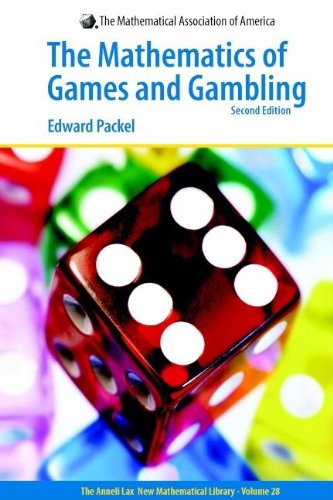
Edward Packel
The Mathematical Association of America | 2006 - 2.ª edição| 190 páginas | rar - pdf | 880 kb
link
password: matav
The first edition of this book was reprinted eight times! This book introduces and develops some of the important and beautiful elementary mathematics needed for rational analysis of various gambling and game activities. Most of the standard casino games (roulette, , blackjack, keno), some social games (backgammon, poker, bridge) and various other activities (state lotteries, horse racing, etc.) are treated in ways that bring out their mathematical aspects. The mathematics developed ranges from the predictable concepts of probability, expectation, and binomial coefficients to some less well-known ideas of elementary game theory. The Second Edition includes new material on: sports betting and the mathematics behind it; Game theory applied to bluffing in poker and related to the “Texas Holdem phenomenon”: The Nash equilibrium concept and its emergence in the popular culture: Internet links to games and to Java applets for practice and classroom use. The only formal mathematics background the reader needs is some facility with high school algebra. Game-related exercises are included at the end of most chapters for readers interested in working with and expanding ideas treated in the text. Solutions to some of the exercises appear at the end of the book.
Contents
Preface to the First Edition ix
Preface to the Second Edition xiii
1 The Phenomenon of Gambling 1
1.1 A selective history . . . 1
1.2 The gambler in fact and fiction . . . 5
2 Finite Probabilities and Great Expectations 13
2.1 The probability concept and its origins . . 13
2.2 Dice, cards, and probabilities . . 15
2.3 Roulette, probability and odds. . 17
2.4 Compound probabilities: The rules of the game . . 20
2.5 Mathematical expectation and its application .. . 22
2.6 Exercises . . 26
3 Backgammon and Other Dice Diversions 29
3.1 Backgammon oversimplified . . 29
3.2 Rolling spots and hitting blots . . 32
3.3 Enteringand bearingoff . . 34
3.4 The doubling cube . . 36
3.5 Craps . . 40
3.6 Chuck-a-Luck . . . 45
3.7 Exercises . . 47
4 Permutations, Combinations, and Applications 51
4.1 Careful counting: Is order important? . . 51
4.2 Factorials and other notation . . 53
4.3 Probabilities in poker . . 55
4.4 Betting in poker: A simple model . . 59
4.5 Distributions in bridge . . 67
4.6 Keno type games . . 71
4.7 Exercises . . 73
5 Play it Again Sam: The Binomial Distribution 79
5.1 Games and repeatedtrials . . 79
5.2 The binomial distribution . . 79
5.3 Beating the odds and the “law” of averages . . 83
5.4 Betting systems . . 90
5.5 A brief blackjack breakthrough. . 93
5.6 Exercises . . 95
6 Elementary Game Theory 99
6.1 What isgame theory? . . 99
6.2 Games in extensive form . . 100
6.3 Two-persongames in normal form . . 105
6.4 Zero-sumgames . . 107
6.5 Nonzero-sum games, Nash equilibria and the prisoners’ dilemma . 113
6.6 Simple n-persongames . . 118
6.7 Power indices. . 120
6.8 Games computers play . . . 123
6.9 Exercises . . . 129
7 Odds and Ends 135
7.1 The mathematics of bluffing and the Texas Holdem invasion . . 135
7.2 Off to the races . . 141
7.3 Lotteries and your expectation . . . 147
7.4 The gambler’s ruin . 158

Sem comentários:
Enviar um comentário