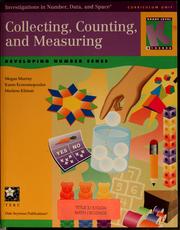
Investigations in number, data, and space
Megan Murray, Karen Economopoulos, Marlene Kliman
Dale Seymour Publications | 1998 | 168 páginas | PDF | 13,4 Mb
Ano de escolaridade: Pré-escolar
Nenhum link disponível
Students will explore numbers and number relationships through a variety of counting experiences. They will count sets of classroom materials. They will make counting books, and count and compare the number of letters in their names. They play mathematical games and solve mathematical problems that involve counting and accumulating amounts. With repeated opportunities to count in real ways, students build their knowledge of the counting sequence and of the quantities those numbers represent. Through the unit students begin to explore ways to use pictures, numerals, objects, and words to represent the quantities they count. In addition to their work with counting, students explore the concept of measurement as they directly compare the lengths of objects to find out which is longer.
Investigation 1: Counting Books Students will: think about what, when, and why people count; recognize numerals and number names; connect numerals to the quantities they represent; create a set of a given size; develop strategies for counting and keeping track of quantities; and represent quantititew with pictures, numerals, or words.
Investigation 2: Taking Inventory
Students will: connect numerals to the quantities they represent; develop strategies for counting and keeping track of quantities; create a set of a given size; and represent quantities with pictures, numerals, or words.
Investigation 3: Comparing Towers
Students will: develop and use language to describe and compare lengths; measure by direct comparison; develop strategies for counting and keeping track of quantities; represent quantities with objects, pictures, numerals, or words.
Investigation 4: Counting and Comparing
Students will: count groups of objects; create a set of a given size; compare quantities to determine which is more; use terms to describe and compare amounts; keep track of the size of a growing collection; find the total of two single-digit numbers; and record mathematical work.
Investigation 5: Least to Most
Students will: count sets of objects; compare quantities to determine which is more; use appropriate language to describe and compare amounts; order quantities from leat to most or most to least; represent mathematical work.
Investigation 6: Arrangements of Six
Students will: find ways to visualize and arrange a set of six objects; solve a problem with many possible solutions; develop strategies for counting and keeping track of quantities through about 12; represent quantities with objects, pictures, or numerals, compare quantities to determine which is more; use language to describe and compare amounts; and order from least to most.

Sem comentários:
Enviar um comentário