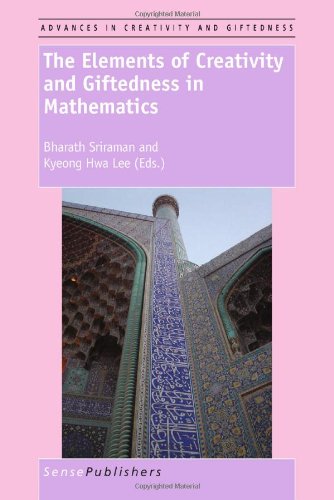
Sense Publishers | 2010 | 240 páginas | PDF | 9 MB
The Elements of Creativity and Giftedness in Mathematics edited by Bharath Sriraman and KyeongHwa Lee covers recent advances in mathematics education pertaining to the development of creativity and giftedness. The book is international in scope in the "sense" that it includes numerous studies on mathematical creativity and giftedness conducted in the U.S.A, China, Korea, Turkey, Israel, Sweden, and Norway in addition to cross-national perspectives from Canada and Russia. The topics include problem -posing, problem-solving and mathematical creativity; the development of mathematical creativity with students, pre and in-service teachers; cross-cultural views of creativity and giftedness; the unpacking of notions and labels such as high achieving, inclusion, and potential; as well as the theoretical state of the art on the constructs of mathematical creativity and giftedness. The book also includes some contributions from the first joint meeting of the American Mathematical Society and the Korean Mathematical Society in Seoul, 2009. Topics covered in the book are essential reading for graduate students and researchers interested in researching issues and topics within the domain of mathematical creativity and mathematical giftedness. It is also accessible to pre-service and practicing teachers interested in developing creativity in their classrooms, in addition to professional development specialists, mathematics educators, gifted educators, and psychologists.
ContentsAIMS AND SCOPE
1. WHAT ARE THE ELEMENTS OF GIFTEDNESS AND CREATIVITY IN MATHEMATICS?: An Overview of the KMS-AMS Symposium and the Book
INTRODUCTION
ACKNOWLEDGEMENT
2. AN EXPLORATORY STUDY OF RELATIONSHIPS BETWEEN STUDENTS’ CREATIVITY AND MATHEMATICAL PROBLEM-POSING ABILITIES: Comparing Chinese and U.S Students
INTRODUCTION
CONCEPTUAL FRAMEWORK
Guilford’s Structure of Intellect Model
Mathematical Problem-posing Framework
STUDY VARIABLES AND DEFINITION OF STUDY TERMS
Definition of Creativity
Definition of Mathematical Problem Posing
RESEARCH DESIGN
PARTICIPANTS
Participants from China
Participants from the United States
MEASURES AND INSTRUMENTATION
The Mathematics Content Test
The Torrance Tests of Creative Thinking
The Mathematical Problem-Posing Test
The Translation of the Tests from English to Chinese
DATA ANALYSIS
The Scoring of the Mathematics Content Test
The Scoring of the TTCT Tests
The Scoring of the Mathematical Problem-posing Test
RESULTS
Comparison of the Mathematics Content Test Scores
Comparison of TTCT Scores
Comparison of the Mathematical Problem-posing Test Scores
Correlations between TTCT and the Mathematical Problem-posing Test
DISCUSSION
LIMITATIONS OF THIS STUDY
The Participants
The Translation of the Instruments
The Time and Distance Restrictions
CONCLUSIONS AND IMPLICATIONS
REFERENCES
3. ARE MATHEMATICALLY TALENTED ELEMENTARY STUDENTS ALSO TALENTED IN STATISTICS?
INTRODUCTION
CONCEPTUAL ANALYSIS OF AVERAGE
METHOD
Participants
Tasks
Administration and Analysis
RESPONSES AND FINDINGS
Average as Being Representative
Mathematical Abstract Construction
Treatment of Variation
SUMMARY AND DISCUSSION
REFERENCES
4. DOES HIGH ACHIEVING IN MATHEMATICS = GIFTED AND/OR CREATIVE IN MATHEMATICS
INTRODUCTION
CREATIVITY AND MATHEMATICAL CREATIVITY
The Gestalt principle:
The Aesthetic principle:
The Scholarly principle:
The Free market principle:
The Uncertainty principle:
INTELLIGENCE AND MATHEMATICAL INTELLIGENCE
GIFTEDNESS AND MATHEMATICAL PRECOCIOUSNESS
Exceptional Abilities from a Young Age
Late Development of Mathematical Giftedness
Identifying Precociuosness
Programmes for the Highly Gifted Youth
SEVEN CASES OF VARIOUS LEVELS OF GIFTEDNESS AND ACHIEVEMENT
John, Gifted but not High Achieving in Mathematics
Lisa, High Achieving Merely through Hard Work
Steve, Late Discovery of Mathematical Precociousness
Annie, Initially a High Achiever by Strategic Social and Mathematical Behaviour
Chris, from Above Average to Low Achieving
Mary, High Achieving, Gifted and Creative
Nelly, Gifted but not Creative
DISCUSSION
The Labels High Achiever, Gifted and Creative in Mathematics
Social Impact and Changed Development
Assessment and School Practice
REFERENCES
5. DEVELOPING MATHEMATICAL POTENTIAL IN UNDERREPRESENTED POPULATIONS THROUGH PROBLEM SOLVING, MATHEMATICAL DISCOURSE AND ALGEBRA
INTRODUCTION
THEORETICAL FRAMEWORK
Participation Gap among Diverse Learners in Accessing Rigorous Mathematics
METHODOLOGY
Participants
Design Features of the Project
Focusing on the Core Traits of Mathematically Proficient Students
Procedures
RESULTS
Selecting Tasks and Sequences of Related Problems
Integrating Pedagogical Content Tools to Extend Students’ Reasoning
Orchestrating Classroom Discourse through Pedagogical Moves and Questioning
CONCLUSIONS
REFERENCES
6. ON TRACK TO GIFTED EDUCATION IN MATHEMATICS IN SWEDEN
INTRODUCTION
A HISTORICAL REVIEW – DEVELOPMENT OF THE SCHOOL SYSTEM AND THE CURRICULUM
NATIONAL POLICIES
ADVOCACY
GIFTED EDUCATION RESEARCH RELEVANT FOR MATHEMATICS EDUCATION
GIFTED EDUCATION IN THE SWEDISH TEACHER EDUCATION
IMPLEMENTATION OF GIFTED EDUCATION IN SCHOOLS
CHALLENGES FACING SWEDISH GIFTED EDUCATION IN MATHEMATICS
Legal Recognition of Gifted Students
Strengthening the Connection between Research and Implementation of Gifted Education
Identification of Gifted Students
Gifted Educa tion in the Swedish Teacher Education
Coordinating Measures for Gifted Students
Social Dimensions of Giftedness
CONCLUDING REMARK
REFERENCES
7. TEACHERS’ IMAGES OF GIFTED STUDENTS AND THE ROLES ASSIGNED TO THEM IN HETEROGENEOUS MATHEMATICS CLASSES
INTRODUCTION
THEORETICAL BACKGROUND
Mathematically able Students
Teachers of MAS
THE STUDY
Participating Teachers
Procedure
Data Analysis
FINDINGS
Teachers’ Images of Gifted Students
High abilities as a gift of god.
A gift is like a jug with a narrow opening.
A gifted student is a cyclamen with a lowered head.
Students’ Roles in the Classroom
MAS as a catalyst for class discussion.
MAS as a scaffold for class discussion.
MAS as a springboard for class discussion.
CONCLUDING REMARKS
NOTES
REFERENCES
8. MATHEMATICAL CREATIVITY AND MATHEMATICS EDUCATION: A Derivative of Existing Research
INTRODUCTION
IDENTIFICATION AND DEVELOPMENT OF MATHEMATICAL CREATIVITY
THE PROCESS OF CREATIVE MATHEMATICAL ACTIVITY
THE WALLAS MODEL OF PROBLEM SOLVING
MORE REMARKS ON INCUBATION
FALLIBILITY AND CRATIVE MATHEMATICAL ACTIVITY
THINKING AS MATHEMATICIANS
CONCLUSION
NOTES
REFERENCES
9. GIFTED EDUCATION IN RUSSIA AND THE UNITED STATES: Personal Notes
ABOUT MY EXPERIENCE
ON TECHNOLOGY IN MATHEMATICS GIFTED EDUCATION
ON THE PLACE OF TEACHING THE MATHEMATICALLY GIFTED IN THE EDUCATION SYSTEM
SOME PRACTICAL OBSERVATIONS
Public Opinion
Opportunities for Children
On Teachers
CONCLUSION: SO WHAT SHOULD WE DO?
REFERENCES
10. SEMIOTIC MICROWORLD FOR MATHEMATICAL VISUALIZATION
INTRODUCTION
MICROWORLD TOOLS FOR MATHEMATICAL VISUALIZATION
SEMIOTIC TOOLS FOR MATHEMATICAL VISUALIZATION
MATHEMATICAL VISUALIZATION WITH TURTLE BLOCKS
CLOSING REMARKS
REFERENCES
11. MATHEMATICALLY GIFTED STUDENTS IN INCLUSIVE SETTINGS: The Example of New Brunswick, Canada
INTRODUCTION: CONTEXT AND ISSUES
GIFTED EDUCATION IN CANADA: A BRIEF PORTRAYAL
NEW TRENDS IN MATHEMATICS EDUCATION: WHAT DOES IT BRING TO GIFTED STUDENTS?
INNOVATIVE PROJECTS AND NEW OPPORTUNITIES FOR GIFTED
EXAMPLES OF EXTRACURRICULAR INITIATIVES
CONCLUSIVE REMARKS ON UNSOLVED ISSUES
REFERENCES
12. PROSPECTIVE SECONDARY MATHEMATICS TEACHERS’ MATHEMATICAL CREATIVITY IN PROBLEM SOLVING: A Turkish Study
CONCEPTUAL FRAMEWORK
THE STUDY
THE PROBLEMS
DATA SOURCES
A SAMPLE PROBLEM AND SOLUTIONS
Problem
S9’s Solution for the Problem
S5’s Solution to the Problem
S4’s Solution for the Problem
Excerpt from S4’s Journal [solution has been translated/described above]
DATA ANALYSIS AND RESULTS
FINDINGS AND DISCUSSION
Logical Thinking
DISCUSSION
Difficulties
Creative Thinking Skills
Personal Choices
Logical and Intuitive Thinking
Other Affective Factors
Differences between Uses of Strategies
CONCLUSIONS
NOTES
REFERENCES
13. WHAT CHARACTERISES HIGH ACHIEVING STUDENTS’ MATHEMATICAL REASONING?
INTRODUCTION
Research Question
Literature Review
CONCEPTUAL FRAMEWORK
CREATIVE REASONING
IMITATIVE REASONING
Memorized Reasoning
Algorithmic Reasoning
METHODS
Procedures
Participants
Tasks
ANALYSIS
METHODOLOGICAL ISSUES
Validity
Reliability
RESULTS
Attacking the Problem
– Alf Description
Interpretation
– Anna Description
Interpretation
– Hege Description
Interpretation
The Prompt and Solution
– Alf Description
Interpretation
– Anna Description
Interpretation
– Hege Description
Interpretation
DISCUSSION
REFERENCES
14. FOSTERING CREATIVITY THROUGH GEOMETRICAL AND CULTURAL INQUIRY INTO ORNAMENTS
INTRODUCTION
CREATIVITY PATHWAYS
MATHEMATICS EDUCATION IN CULTURAL CONTEXT
EDUCATIONAL FRAMEWORK
EXAMPLES OF CREATIVE ACTIVITIES
Example 1
Example 2
Example 3
Experience of Learning Mathematics with Applications
Experience of Learning Geometry in Cultural Context
Experience of Connecting Geometry with Culture and Art
Geometrical View of Visual Patterns
Curiosity and Pride in Own Cultural Heritage
Interest, Motivation and Readiness to Teach Geometry in Cultural Context
Self-directed Inquiry
The Impact of the Technion Seminar
DISCUSSION AND CONCLUSION
ACKNOWLEDGEMENT
REFERENCES

Sem comentários:
Enviar um comentário