David Salsburg
W. H. Freeman | 2001 | 352 páginas | djvu | 6 Mb
link
link1
PDF - 4,5 Mb
link
link1
4shared.com
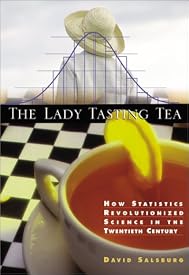
Descrição: In the 1840s, astronomers used Newton’s mathematical laws to predict the existence of another planet. And Neptune was discovered--right where it was supposed to be. For the first time, the universe seemed to make sense. It ran like a clock and scientists understood the mechanics perfectly. But errors began to mount, and by the end of the nineteenth century the clockwork universe had broken down. Gradually, a new paradigm arose in its place—the statistical model of reality. In THE LADY TASTING TEA, David Salsburg tells the fascinating story of how statistics has revolutionized science in the twentieth century. Leading the reader through a maze of randomness and probability, the author clearly explains the nature of statistical models, where they came from, how they are applied to scientific problems, and whether they are true descriptions of reality. Salsburg also discusses the flaws inherent in a statistical model and the serious problems they’ve created for scientists as we enter the twenty-first century. Written for the layperson, THE LADY TASTING TEA contains no mathematical formulas. It does contain short, easily digestible chapters, each one built around one of the men or women who participated in the statistical revolution. While readers will not learn enough to engage in statistical analysis (that requires several years of graduate study) they will come away with some understanding of the basic philosophy behind the statistical view of science. And to start, we meet a lady tasting tea...At a summer tea party in Cambridge, England, a guest states that tea poured into milk tastes different from milk poured into tea. Her notion is shouted down by the scientific minds of the group. But one man, Ronald Fisher, proposes to scientifically test the hypothesis. There is no better person to conduct such an experiment, for Fisher is a pioneer in the field of statistics. The Lady Tasting Tea spotlights not only Fisher's theories but also the revolutionary ideas of dozens of men and women which affect our modern everyday lives. Writing with verve and wit, David Salsburg traces breakthroughs ranging from the rise and fall of Karl Pearson's theories to the methods of quality control that rebuilt postwar Japan's economy, including a pivotal early study on the capacity of a small beer cask at the Guinness brewing factory. Brimming with intriguing tidbits and colorful characters, The Lady Tasting Tea salutes the spirit of those who dared to look at the world in a new way.

Sem comentários:
Enviar um comentário